Friday, 29 August 2014

Alternative Tourist Guide to France


Planning to visit France? Get a guidebook, learn some French, and prepare for a fabulous holiday. France is the most-visited country in the world, and for good reason – the countryside is beautiful and the people are friendly. The guidebooks won't mention many idiosyncratic aspects of France which, discovered over the course of many trips there, I feel compelled to mention to any prospective visitor.

French Geography
France has many categories of geographical divisions. An understanding is essential to your tourist planning, most especially interaction with tourism offices.
First, and biggest are the regions; they consist of departments, devolving into communes. Kind of like provinces, counties and municipalities. Just to add to the mix there are also pays - communal regions – without defined borders.
Tourist offices serve different categories, and which one you encounter is a matter of chance. An Office de Tourisme can be very insular and unable to supply you with information for another region which may be just a kilometre away.
To make things even more interesting, you may often be asked by a host “Quelle pays?” asking you which country you come from. Their type of pays is not your type of pays.

French Food
Baguette – without a daily baguette, life is impossible. Should you wish to find the boulangerie in any town, simply find any local carrying their baguette and trace their steps backwards. 
Some quieter parts of the country, however, may only be served by the mobile boulanger. She will drive through the town and hoot loudly just behind you, causing you to crash your bicycle in fright. 
When you have recovered, follow the van at high speed because it may be your only chance to buy bread that day. 


Cheese – The French take cheese very seriously. Anecdotally, there is a fromage for every day of the year in France. The cheese aisle in the supermarché offers an extensive smelly variety: no soapy or rubbery orange blocks for a Frenchman, thank you. 
Battling to choose? Taste the popular camembert called 'Coeur du Lion' – the 'Heart of the Lion'. Try to consume this delicious, value-for-money cheese in one day, because the smell, once opened... well, just think of something that rhymes with heart. 
 
Coffee, tea or chocolate? - At breakfast, why settle for an ordinary beverage when you will be offered a steaming bowl of hot chocolate. The truly decadent dip their croissants into their chocolat
If soggy bread isn't for you, fear not - there will be a formidable array of jams on the table. Your hostess will ensure she tells you if they are home-made, as artisanal products are prized in France.
NB. In French these are confitures. Don't make the mistake of Americans (who call their jam preserves) of asking for preservatifs – indeed, in French these are not jams but condoms.

French Life
Opening hours – Visits to shops and attractions alike require forward planning. Lunchtime (closed) spans two hours at least. On Sundays, about 99% of France (except the boulangerie) is closed. In the countryside, this used to also apply to Mondays. We soon learnt to carry emergency food supplies, after one sad Monday lunchtime eating dry baguette and leftover squashed nougat extracted from the bottom of my bicycle pannier in the parking lot of the umpteenth closed supermarket we tried. 
Indeed, it often seemed that remote chateaux and museums were only open on the third Thursday of every month, between 3pm and 4pm. This may account for us not visiting many.
Things are changing, slowly, and some smaller supermarkets open on Sunday mornings. It is most convenient, but also shows how French traditions are slowly changing.

Pets – the French love dogs. Most accommodation establishments accept pets, for a small surcharge. You can buy a ticket to take your dog on the train. Some cyclists take their dogs for a spin in a pet carrier.  
This is all because French dogs are more poetic than English-speaking mutts; they don't woof, they ouarf.

The Language
If you wish to travel independently, learn some French. The most important word for any traveller is Bonjour – essential to politely starting any new interaction, and without which you will be considered rude.
Just before you think you are better at French than you actually are because some French words resemble English, they both have Latin roots but the spin is different. To ask is demander in French – much more polite than the word suggests in English. Preserves and preservatifs are an aforementioned excellent example. 
 
The phrase books won't include many indispensable French words:
Poubelle – where you deposit your trash, and perhaps why France is relatively litter-free: it's more inviting to throw it in la poubelle instead of an ugly-sounding rubbish bin.
Scotch – What your French host will eventually determine you need after about half an hour of dictionary-searching and descriptive hand signals, trying to ask for some sticky-tape.
Frotter – generally meaning friction or rubbing. The word frotteur – more double meaning here - has a negative connotation in English, but who could resist one in France – a machine that froths your milk for cappuccino.
Trottoir – the pavement. Take care if a sign warns there is no frotter on the trottoir – you could slip and meet with an accident.

Things we love about France
People – who are friendly, helpful and more easygoing than their European neighbours. They have excellent good road manners towards cyclists. The Gallic shrug is always accompanied by a smile.
Tourist offices – France values their visitors and is very well populated with tourist offices. You will be offered local tourist maps and helped to find accommodation or directed to a supermarket or just about anything.
Flowers – in springtime, flowers abound in every aspect of public and private outdoor life. Roses spill over stone walls in gardens, local councils ensure the flower boxes all over town are bursting with colour. Even in the countryside, you pass abundant fields of poppies and wild flowers. France makes so much effort with their flowers that towns compete for “Ville Fleurie” awards, and we get to enjoy them too.

Things we hate about France
Bolster – a long, hard, sausage-like pillow, found in traditional accommodation establishments, for which there will be night-long wrestling for dominance between the occupants of a double bed. The winner: always the bolster.
Noisy scooters – Many nights in towns we were jolted awake by the 120-decibel drone of a passing unsilenced scooter. We often debate writing to Hollande to ask why he doesn't pass a law banning the removal of the silencer.
Price of icecream – French icecream, which has many exotic flavours such as coffee and coconut, is an expensive treat. As soon as one crosses the border into neighbouring Germany, the price of icecream is halved. One more mystery of the European Union.

More things we love about France: everything else.We can't wait to go back!


Saturday, 17 May 2014

Tips and Tricks for Low-Maintenance Travellers


My job involves travel and so does my hobby, so over the years I have transformed some annoying aspects into manageable ones. I'd like to share the following which may make your life easier on the road, for business or pleasure


My Job
Draw up a packing checklist. Airline pilots use checklists even though they know which knobs and switches to throw – but checklists ensure safety in case of distraction at a critical moment. The same with packing; you may leave home knowing you have clothes, but your heart sinks when you arrive and discover you have left behind a small but crucial item such as your camera charger which may not be easily or cheaply available at your destination. 

Instead of schlepping around photocopies of your passport and important documents (which when kept in your luggage will be pinched along with it) upload electronic versions to a cloud service that can be accessed from any computer. I use Dropbox or save a draft message with attachments in my web mail. 

On the aeroplane get a better night's sleep with earplugs and an eye mask. An eye mask blocks out those lights which just sneak in under your eyelids and keep you awake. My preferred earplugs are silicone (bought at the pharmacy) which are effective and gentle: they don't scrape the skin off inside of your ear canal like the sponge ones, nor transfer those horrid grinding noises to your head from rubbing the pillow during turbulence.

When you arrive at your hotel, hang your crinkled clothes on a hanger in the shower (out of the spray, naturally). The steam removes most wrinkles. It beats ironing and works spectacularly well on wool items.

My Hobby
Laundry – a bugbear of a long trip. In the old days, airline crew joked that if your flight was delayed a day, turn your undies inside out and wear again. Assuming you are more discerning and don't feel like paying megabucks to have your delicates laundered, you will need to wash. Roll up wet clothes tightly in a towel to remove maximum moisture before you arrange them on clothes hangers around the room. This will also obviate disapproving looks from nosey parker guest house owners who inspect your room for dripping washing when you're out. 

On that note avoid packing pure cotton socks; they are a traveller's drying nightmare unless your upmarket hotel bathroom has a heated towel rail, or you are journeying through the desert and can arrange them under bungy cords to your camel/vintage motorcycle pannier.

Despite all the yummy-seeming restaurants in foreign parts, sometimes you just want a comforting snack in your room of something perishable and want to avoid expensively dislodging items in the forbidding automatic minibar. In cool weather you're in luck: pop your tub of yoghurt onto the windowsill at night where it will stay preserved enough so as not to lay you low the next day.

Broken luggage straps, or ripped bags? Sew them up with dental floss – unbreakable. This is presupposing 'sewing kit with large-enough-eyed needle' was an entry on your packing checklist.

Voila! It's fixed! And you can relax until you arrive at the best destination there is….. home. 

Wednesday, 16 April 2014

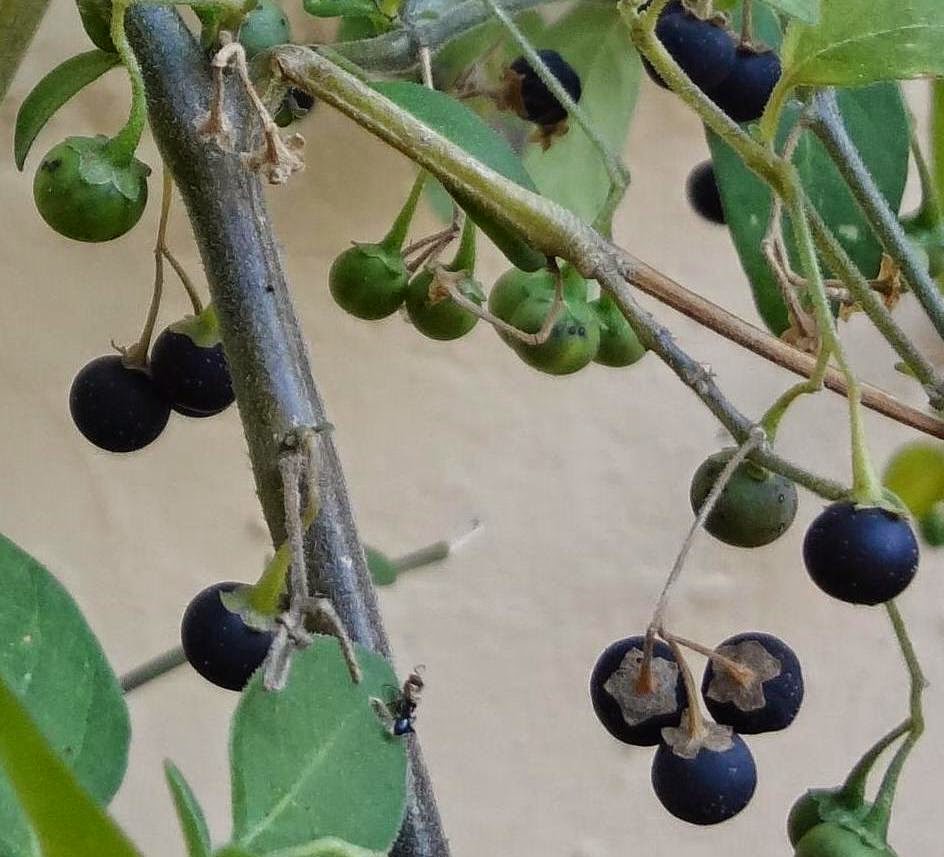
How to Make Umsoba / Msoba / Nightshade / Nastergal Jam


Ingredients: 
Umsoba berries, Sugar, Patience. 

Preparation Time: About a year

This recipe written due to the dearth of reliable information on the internet about making this jam, more keenly felt after the strange outcome of my first batch. 

Step 1: Allow these 'weeds' to grow in your garden.
The plants are a Solanum variety. Possibly Solanum Retroflexum, possibly Solanum Nigrum. The confusion may be due to there being approximately 1500 Solanum species to choose from - including potatoes, tomatoes, bugweed and Jerusalem cherries (the latter two being Category 1 invasive alien vegetation). 
Apparently, several are suitable for this jam - those whose berries turn black and dull when ripe.

The berries are reportedly poisonous when green, plus there was always the spectre of 'Deadly Nightshade'. This was a mild deterrent; but since there weren't any dead doves littering our garden after they lunched in my umsoba patch, I felt a little more secure.

Besides, the faint risk that your jam may kill is a perfect excuse to keep it all to YOURSELF.

Step 2: Wait for the berries to turn black, then gather as they ripen. Pull or cut off. 
I rinse, dry and freeze every small batch I gather, until I have amassed a suitable quantity. 
Collecting enough may take months, even years. This step is the true labour of love.

Don't worry too much about the stalks. The greener ones cook down, the dry ones add crunch.


Step 3: Prepare. Blanch frozen berry collection in a bicarbonate-of-soda solution, which will turn copper-sulfate-y blue. 

This was the crucial step missing from my first batch, which tasted strangely coppery. 
I subsequently reboiled each jar on opening with a spoon of bicarb (baking soda if you're American), which promptly turned it a similar but even more vicious blue-green than the blanching liquid.
(Things got even more curious when one batch tasted burny. Deadly? No... it transpired that Dear Beloved had used that saucepan to cook up a batch of organic anti-aphid chilli solution)


Step 4: Make jam in standard fashion (1 part fruit, 1 part sugar) Do not add water - the berries will produce enough liquid  and the jam is pretty runny. Ensure the sugar dissolves before it boils. Boil until set point. 

I added an expired packet of commercial pectin I found lurking in the pantry, which probably helped the setting. I don't add lemon juice to avoid harming that unique subtle taste.
Step 5: Bottle. 
I have always sterilised my jars quickly and effectively in the microwave - add some boiling water and reboil in the micro. Never gone wrong.

 VOILA!


Saturday, 5 April 2014

Backwaters of London

One Friday morning at about 11am, I set off from my London hotel to Paddington Basin, where I joined a small assorted group of in-the-know travellers who had come together for a common purpose: to witness the Rolling Bridge. At midday, the event began. Staff from the adjacent office block emerged and rolled it up and rolled it down again, then handed out postcards as a souvenir.


The Rolling Bridge was built in 2004, to span a small canal inlet next to Marks and Spencer's new HQ – but be movable, to allow access for the occasional boat (not a large one). Indeed, so small is the inlet, I couldn't help surmising that the bridge was a vanity project. It takes only a few steps to walk around the little basin, something possible for all but the terminally lazy. 

This engineering marvel is 12m long and built in eight sections, connected by links and moved by hydraulic cylinders that extend and pull the bridge in on itself to form a circle. Since there isn't much boat traffic, the bridge is exercised every Friday at noon, and the operators appear to enjoy the appreciation of the small audience. 


Since the day was turning out fine, I explored further up the Grand Union canal and soon came upon another basin that formed a junction of three canals: Little Venice. Over a picturesque bridge stood a pretty narrowboat 'Jason' tied up to the side. When I realised that tourists were boarding, I dashed over to find it was about to depart on the tour to Camden Lock known as 'Jason's Trip'. 

And so I discovered the quiet secret world along a green and cool byway: Regent's Canal. We glided past present-day boat communities and were given fascinating descriptions of life on board in times past, when entire families lived in cramped little cabins and plied their boats around London transporting goods ranging from coal to imported Norwegian ice. 


The boat puttered along between Regent's Park and the London Zoo, where our guide pointed out the large Snowdon Aviary containing Sacred Ibis. I found it ironic that they are considered interesting enough to display in London – whereas in Johannesburg they are as common as mossies (sparrows for non-South Africans).

We throbbed through a tunnel with no towpath – before engines, crews had to 'walk' their boats through, lying flat and pulling with their feet along the sides of the tunnel. We were shown Banksy drawings above the water and informed on the politics of competing graffiti artists. It was a delightful sojourn in a part of London I never knew existed.

The towpath follows the canal almost all the way, and it's another outing to see the canal from the sidelines all the way, if you will, to King's Cross.


The 45-minute journey ended at Camden Lock, where one can visit Camden Market, a vibey spot, but I'd been several years ago and had vague memories of ageing hippies flogging tie-dyed kaftans and home-made bead bracelets, alternating with stalls manned by menacing skinheads selling heavy-death-metal-goth-rock T-shirts and marijuana-leaf stickers. 


The busyness continues across the High Street at Camden Lock Village, where you can sit on an old scooter facing the locks and munch the wares of the fast-food outlets. And so I was back among the throng of tourists and I regretfully left the peace of the canal behind, and rejoined the bustle of London life. 


'Jason's Trip' runs every day between April and October. Visit www.jasons.co.uk for timetables and information about a lovely English summer day out. 


I made this trip in 2011 and 2014, and also walked the towpath in 2011.